Systems and benchmarks
Projects
Research systems, benchmarks, and efficient inference methods with their public artifacts.
Training-Free Multimodal LLM Orchestration
Problem. How can an interactive omni-modal assistant coordinate heterogeneous expert models without retraining a monolithic model?
Method. LLM-based routing composes off-the-shelf modality experts with persistent cross-modal memory and interruption-aware streaming interaction.
- Role
- First author
- Status
- Paper, code, and research note available
SocialOmni
Problem. Existing omni-model benchmarks underrepresent time-sensitive audio-visual social interaction.
Method. A standardized benchmark and dataset evaluate social perception, temporal grounding, and interactive response behavior across audio and video.
- Role
- First author
- Status
- Paper, code, and dataset available
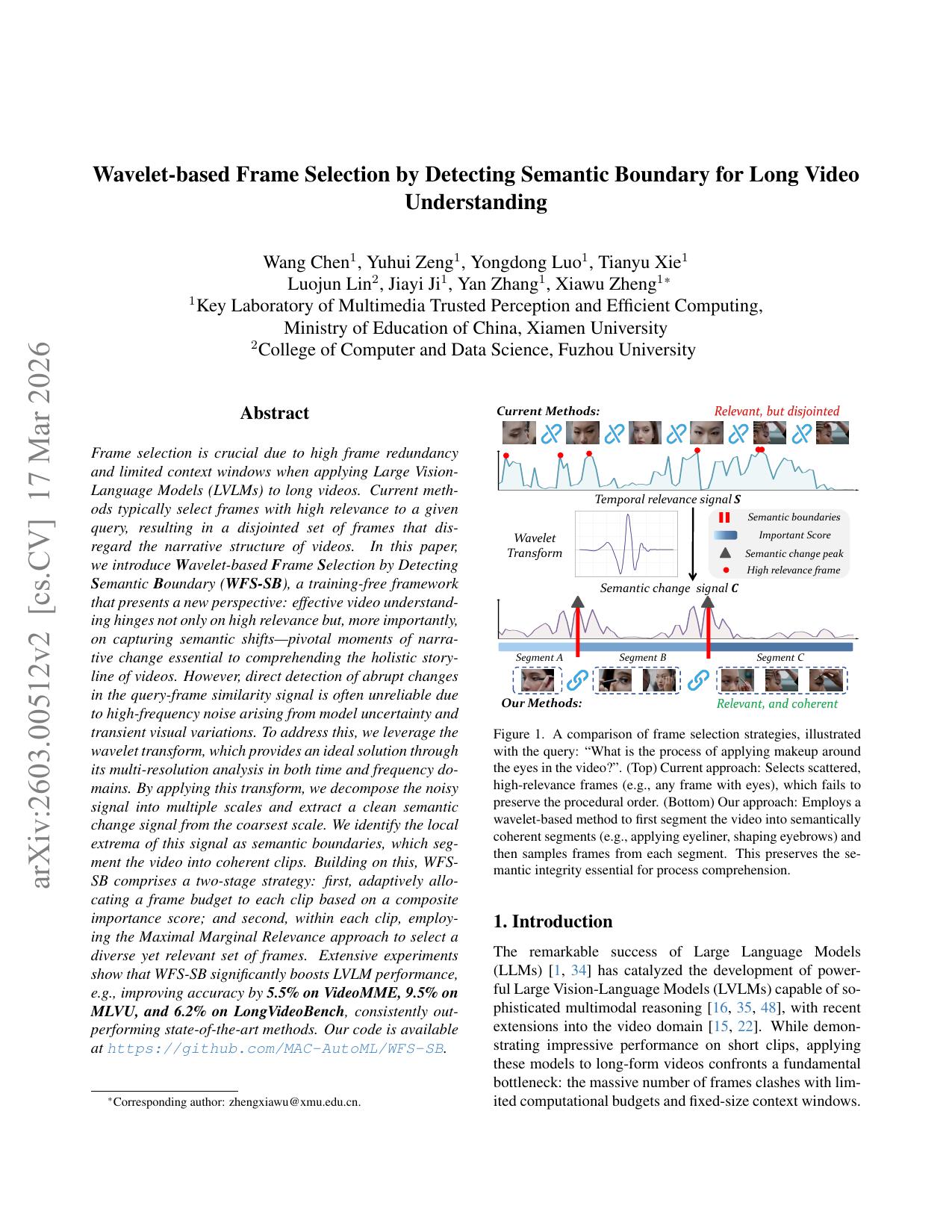
Long-video Frame Selection
Problem. Long-video models spend substantial computation on redundant frames while missing sparse semantic events.
Method. Event anchors and wavelet-detected semantic boundaries guide adaptive frame allocation without training an additional selector.
- Role
- Fourth author on WFS-SB
- Status
- WFS-SB accepted; EFS preprint available

Correct While Verifying
Problem. Speculative decoding discovers incorrect draft tokens only after final verification, then discards the entire suffix following the first rejection.
Method. Intermediate target-model states predict correct continuations early, seed correction branches, and verify original and corrected drafts in parallel.
- Role
- Fifth author
- Status
- AAAI 2027 submission; project note available